Why Nervousness Shouldn’t Stop You
Come nervous.
You do not have to wait until you feel brave, confident or ready. There is no such thing as being too nervous to learn woodwork.
I have been teaching women beginners for 30 years, and many of the women who arrive at my workshops are nervous. Some tell me outright. Others do not need to say a word.
They may avoid eye contact, sit very still or speak very little to the other women. When I ask what they would like to feel by the end of the workshop, the answer is often the same.
Confidence.
Some tell me they know absolutely nothing about woodwork because they were never given the opportunity to learn. Their father may have been a carpenter, yet they were not allowed into his workshop. Perhaps they were yelled at for going near the machines.
Even highly educated women with powerful careers can feel deeply nervous.
One woman had responsibility for a large team of medical professionals. She wrote articles, managed urgent situations and was used to taking care of everyone around her. In the workshop, she found it difficult to switch off that role.
When another student asked a question, I gently reminded her that it was all right for me to answer. She did not have to take charge of the room.
Nervousness does not always look like fear. Sometimes it looks like silence. Sometimes it looks like overthinking, asking many questions or trying to stay in control.

Woodworking for Beginners Starts With Feeling Safe
When a woman arrives at one of my workshops, I do not try to talk her out of being nervous.
Instead, I create an environment in which she has fewer reasons to feel nervous.
Even if I am speaking to someone else when she arrives, I stop and greet her properly. I offer my hand, and sometimes I ask whether she would like a hug, particularly if she has been lost, running late or has driven a long way.
Then I show her where to put her bag and where to find the bathroom. These things may seem small, but someone who has been driving for hours may be very grateful to know where everything is before she is expected to learn.
The chairs are arranged in a semicircle near me. I tell my own story in no more than four minutes, including the fact that I struggled when I began.
I was not naturally good at woodwork. I called myself cack-handed because I seemed to do everything backwards. I kept learning through repetition because I enjoyed it and wanted to continue.
Sharing that helps women understand that I am not standing in front of them as someone who found everything easy. My early struggles are part of the reason I now love teaching and uncovering the gold in other people.
I am playful, natural and human. I ask whether everyone is warm enough or whether the sun is in someone’s eyes.
There are no tools laid out on the bench as a silent test of what they are expected to know. The tools appear gradually as the lessons unfold, and the women get to choose and handle them.
Learning close together changes everything
I teach at one central bench. The students gather closely around it on stools so they can see what I am doing and pass tools to one another.
They are not standing behind separate benches, miles away from the teacher, trying to work out which mysterious button is being pointed to from across the room.
I have seen teachers hold up a drill from three or four metres away and say, “This button does this, and that button does that.”
But which button? How can anyone see?
Women need a close-up. They need time to look, touch, ask and understand.
I use everyone’s name, partly because it helps me remember and partly because being called by your name matters. In larger groups, a piece of masking tape with each person’s name works perfectly well.
During the first hour, I introduce the parts of the project rather than presenting a perfect finished example.
I do not want the women to see a polished model and immediately compare their work with mine. Nor do I want them to copy it without considering what size and dimensions would suit their own purpose.
Every woman goes home with a project made for her, not a replica of mine.
Together, we create a drawing, make a cutting list and do the necessary maths. As the pieces begin to make sense, the women start to see the bigger picture.
They are not simply following instructions. They are beginning to understand the industry they are entering.
How Nervous Women Can Learn Woodworking with Confidence
Many women feel intimidated walking into a hardware store.
They worry that they will not know the correct words, ask the right questions or be taken seriously.
I teach them that they do not need to know everything. They only need a few useful words and the confidence to ask for the information they require.
We talk in metres and millimetres. We do our homework before going to the hardware store. We hold the expectation that we will be spoken to properly.
If someone does not treat us well, we can say thank you and find someone else.
Most shopkeepers genuinely want to help. The difficulty comes when we ask a question that is too broad, such as, “What wood should I use to make a frame?”
The person behind the counter cannot know what kind of frame, how large it will be, where it will be used, what weight it must carry or what finish we want.
So I teach women how to work out what they need to know before they arrive.
This gives them an enormous sense of relief. They do not have to memorise one perfect question. They simply need to understand their own project well enough to know what information is missing.
By morning tea on the first day, the excitement in the room is often palpable.
They can see that woodwork is achievable, and that their project is in their own hands.
Common Fears About Learning Woodwork
Many women have been warned that power tools are hard to learn or dangerous.
Often these warnings come from well-meaning partners, family members or friends. But repeated warnings can create fear long before a woman touches a tool.
I sometimes describe power tools as appliances in disguise.
That does not mean I am casual about safety. I am very precise about safety.
But my safety talks are not designed to terrify people with descriptions of everything that could go wrong.
Fearful people do not learn well.
I was once invited to teach a group of women at a men’s shed in another state. We were only using hand tools, including chisels, mallets and clamps.
Before I could address the group, the head of the men’s shed pointed around the large workshop and explained how incredibly dangerous all the machines were.
By the end of his talk, the women were very still and one had gone quite pale.
Once we had gathered around our workbench, I addressed it immediately. I told them I was sorry they had been introduced to such an enjoyable course with that awful warning.
I promised to keep them safe. I told them we would have fun, that the work was achievable and that they were going to learn a great deal.
At the end of the session, a young woman came to me with tears in her eyes. She said she had been about to walk out after hearing the warning because she was so frightened.
Language can create fear in a room before anyone touches a tool. A good teacher must understand that.
What Good Woodworking for Beginners Looks Like
When I tell a group that we celebrate mistakes, some women giggle with relief.
Others look alarmed. They wonder whether the workshop will be careless or slapdash.
They soon discover that we work with precision. Celebrating mistakes does not mean ignoring accuracy. It means understanding that mistakes are part of learning and can often be repaired.
One woman was driving screws into her project when a screw came through the inside wall. She did not notice at first.
I stayed nearby and waited.
When she finally saw it, she cried out, “Oh my goodness. Oh no!”
Everyone stopped and looked.
I asked her, “How are you feeling right now?”
She said, “I’m devastated. I’ve ruined my project.”
I asked, “What if you haven’t ruined it? What if it is fixable, and you can fix it?”
She looked at me in disbelief.
With her permission, I invited the others to gather around. I explained that this was a wonderful opportunity because everyone could learn how easily this mistake could happen and how it could be repaired.
Then I asked the woman what she thought she should do first.
She considered it and said, “Take out the screw.”
Exactly.
Through a series of questions, I helped her work out the next steps herself. We used glue, tape and clamps. Within an hour, including the drying time, the tape was removed and the damage was repaired.
When the others came back to look, they could barely see where it had been.
Mistakes show us how capable we are of fixing things.

Questions Deserve Serious Answers
Women often need something from a teacher that they have not received elsewhere.
They need the why.
It is not enough to say, “This is the screw we use.”
Why that screw? What does its gauge mean? Why is it suitable for this material and this job?
I once asked several people in hardware stores what “8 gauge” meant in relation to a screw. They repeatedly told me it referred to the size.
Yes, but what does the eight actually refer to?
No one seemed to know, so I researched its history myself.
Industries often contain rules and habits that people accept without questioning.
I use the example of a leg of lamb. Why do butchers cut through the shank and fold it back over the leg?
People usually do not know.
The practice began because our great-grandmothers’ ovens were often too small to fit the full length of a leg of lamb. The butcher shortened it by cutting and folding back the shank.
We continue doing it, even though most modern ovens are large enough.
Some rules have sensible origins. Others continue simply because that is how things have always been done.
Women are entitled to ask why.
One woman in my workshop asked a great many questions. I answered what was relevant to the current lesson and explained when something would become relevant later.
I never shut her down.
Later, she thank me and told me she had always been criticised for asking too many questions. She was grateful to be somewhere her questions were welcomed.
When I say, “If it is a question, it is valid,” I often see shoulders drop around the room.
You Can Learn Woodwork Even If You’re Nervous
For women searching for advice about how nervous women can learn woodworking, the answer is not to force themselves to stop being nervous.
The answer is to find teaching that allows nervousness to exist without letting it control the experience.
A well thought out beginner workshop should offer small groups, close demonstrations, patient answers, emotional safety and plenty of hands-on practice.
A nervous woman should not be left alone when something goes wrong.
Nor should another student have to stop her own work to console her because the teacher is too busy managing a large group.
I stay nearby. I step in quietly. Theres no need to single someone out in front of everyone.
When the others are occupied, I may slide onto a stool beside her and ask how she is feeling. Then I stay until she can feel the ground underneath her again.
The signs that confidence is growing
At the end of the first day, the projects are tied with ribbon and the tools are put away.
The women sit together in front of the drop saw, and I ask each of them:
What is one thing you enjoyed?
What is one thing you learned?
What did you do well?
These questions help solidify the day. The women suddenly recognise how much they have accomplished.
A woman who was nervous that morning may turn towards the drop saw and say, “I really enjoyed using that machine.”
She is amazed that she could operate it so easily.
The next sign appears the following morning.
They arrive early.
No one is late. The women who were most nervous are often the first to arrive because they cannot wait to begin again.
By the end of the second day, their questions are often more thoughtful and intricate. Their bodies remember the correct stance. They know how to hold themselves at the tools.
They begin talking about what comes next.
One woman may decide to clean out her shed. Another may move some of her husband’s things aside so she can claim space of her own. Someone may clear out a back room, buy a drill or start looking for a drop saw.
I tell them they can send me a link to a tool they are considering, and I will help them ask the right questions about it.
The change can reach far beyond woodwork.
One husband rang me after the first day and sternly asked, “Patt, what have you done to my wife?”
I stammered for a moment before he laughed.
“She whistles all the time,” he said. “She couldn’t be happier.”
Some women cry at the end because their transformation is deeper than learning how to use a drill or make a project.
They have reclaimed a part of themselves.
In daily life, we are often mothers, partners, bosses, carers and the people responsible for everyone else.
In a workshop, a woman can simply be herself.
That can give her permission to tighten her boundaries, take up space and return home refreshed.
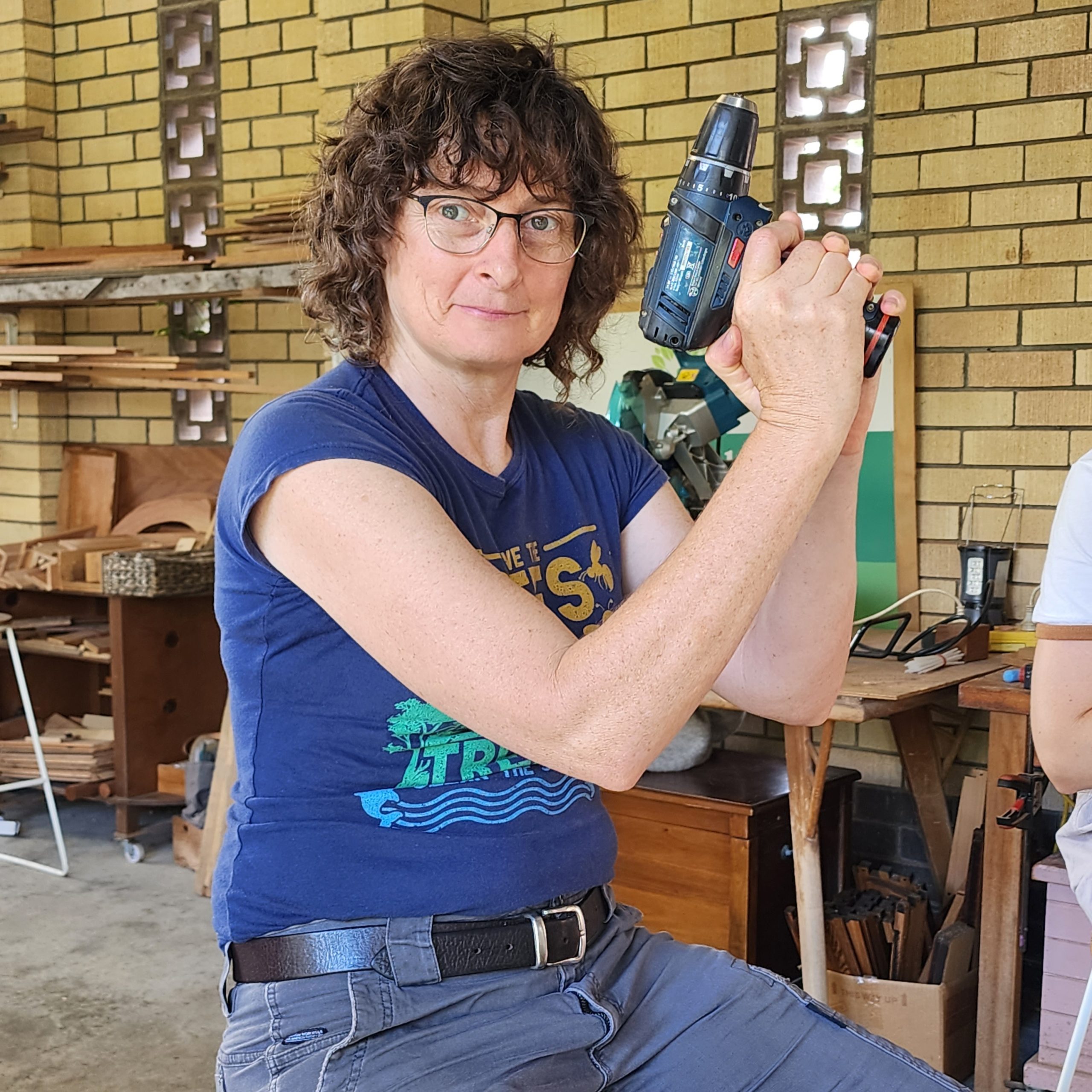
One woman who had felt intimidated in Bunnings held up her drill at the end of the workshop and declared:
“I am woman, hear me roar!”

You are not too nervous
You are not too old.
I have taught women in their eighties and older.
You are not too inexperienced. Complete beginners are my favourite because a blank slate is great fun.
You are not too clumsy. I once believed I was clumsy too.
Physical disability does not automatically exclude someone either. I have taught NDIS participants who attended with carers. When the participant became tired, the carer helped with some of the work.
I taught a woman with a vision impairment by making sure she had plenty of light and checking in occasionally. I did not speak loudly to her or single her out. She had a wonderful time and was just as capable as anyone else.
There is nearly always a way.
I have even taught six-year-olds to use a drop saw safely while closely supervised.
When the teacher is right beside you, adapts to your needs, answers your questions and takes your safety seriously, you may be surprised by what you can do.
So, can you learn woodwork even if you are nervous?
Yes.
Come nervous.
What Is a Tack Cloth and Why Use One Before Finishing Wood?
Fine sanding dust can remain on timber even when the surface looks clean. Learn how using two cloths at different stages can reveal a beautifully prepared surface before applying oil, wax, paint or stain.
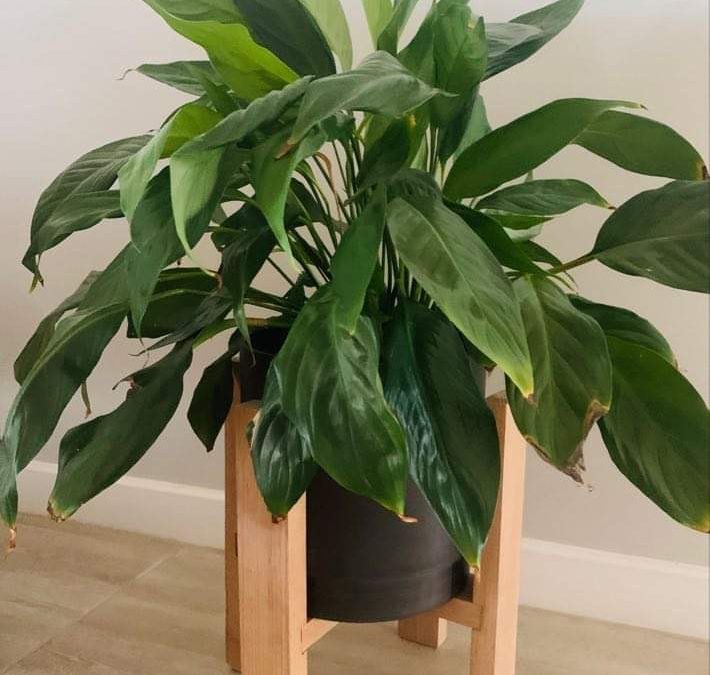
The best beginners project
Start your beginner woodworking journey with the right first project. Learn why a simple shelf or box builds essential skills, confidence and the independence to tackle future woodworking projects with success.
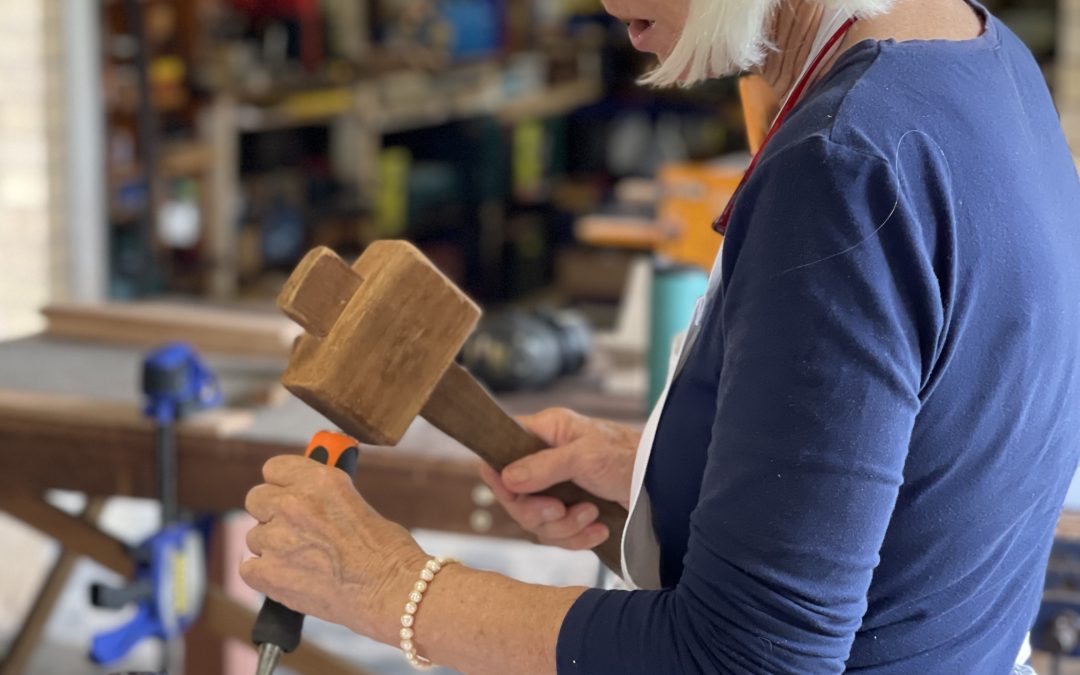
Teaching woodwork without a degree
Thinking about teaching woodworking but don’t have a teaching degree? Discover why experience, preparation and a genuine desire to help others matter far more than formal qualifications.