Can I Teach Woodworking Without a Teaching Degree?
Yes, you can teach woodworking without a teaching degree.
In many ways, it may even give you more room to teach in a way that feels natural to you.
You are not locked into a formal educational system. You can choose your timing, the size of your classes, the people you want to teach, the projects you offer and the atmosphere you create.
Most students are not arriving because they want to feel as though they are back at school. They are coming because they want to understand the tools, techniques, tips and tricks that will help them make something for themselves.
They want the information clearly.
They want to feel welcome.
They want to know that they can learn.
Teaching begins with a decision
Before you ask whether you are qualified enough, there is a more useful question.
Do you enjoy helping people understand?
Teaching is about far more than making things well. It is about enjoying people’s company, noticing when they are uncertain and wanting to help them find their way through.
It helps to be honest about what is drawing you towards teaching.
Is it the money?
The pleasure of making?
The idea of bringing more people into your life?
The enjoyment of making alongside others?
The satisfaction of showing someone how to do something they once thought was beyond them?
There is no wrong answer, but the order matters.
Teaching becomes far more rewarding when the student’s understanding matters to you as much as the project itself.

You do not need to know everything
One of the biggest misunderstandings about teaching woodworking without a degree is the belief that you must be an expert.
You do not.
You need enough knowledge to teach the technique you have chosen, including the correct safety protocols. You need to prepare well. You need to understand the project and the tools you are using.
You are still allowed to pause.
You are still allowed to say:
“Hang on a minute, I have forgotten the next bit.”
You can check your notes.
You can ask the group what they think might come next.
You can take a breath and begin again.
This does not make you less credible. It shows that teaching is human.
There is a great deal to remember. You are holding the practical technique, the safety, the timing, the needs of the group and the words required to explain what your hands may have known for years.
Students often respond warmly to honesty. It gives them permission to be learners too.
My own training taught me what was missing
My woodworking training was excellent in many ways.
No stone was left unturned when it came to specifications, information and techniques.
When it came to learning the actual skills, however, the method was often to demonstrate the action and then leave us alone until we worked it out.
The idea seemed to be that this would separate the naturally talented from those who were not.
I was firmly in the “not naturally talented” group.
But I loved the craft. I wanted to become a carpenter and joiner, so I struggled along and kept going.
That experience shaped the teacher I later became.
I began to understand how much useful information an experienced teacher could offer. Not to take over, but to help a student understand more deeply and avoid feeling abandoned while she tried to make sense of an unfamiliar action.

One step should be one step
When people are learning something they have never experienced before, the steps need to be short at first.
I tell students this before we begin, so they understand there is a plan.
Take something as ordinary as using a try square.
Holding the square, turning it, placing it against the timber and drawing a 90-degree pencil line can easily be treated as four separate actions.
Instead, the learner is often expected to absorb all of it at once.
In my workshops, each action is given enough attention to settle into the body.
We look at stance.
We look at how the tool is held.
We look at the angle of the pencil.
We make sure every student can see the demonstration clearly. Some people naturally step forward for a close look. Others hold back, even when they cannot quite see what is happening.
A teacher must notice that.
The detail is important, yet it does not need to feel complicated.
Repetition matters too, though it does not have to mean endless practice on scrap timber. A project can provide the repetition naturally.
Eight countersinks.
Eight pilot holes.
Eight screws.
Each one gives the student another chance to feel what is happening and become more confident in the action.
Teaching is not about rushing towards the finished object
A good woodworking class is not only about completing a project.
It is about what happens at each step.
The student becomes present.
She begins to understand how the tool feels.
She notices what her body is doing.
She learns to recognise when something is working and when it needs adjusting.
When the class becomes a race to finish, those moments are easily lost.
Teaching asks us to slow the process enough for learning to happen.

Informal does not mean careless
You may be teaching at home, in your own shed or in a community space, but you still carry responsibility.
People need to feel welcome.
There needs to be room for playfulness.
Students need to know exactly what they can expect from the course, no more and no less.
You also have a responsibility to look after your own wellbeing. Teaching can ask a lot of you. If your health, energy or confidence begins to feel at risk, you need a plan for stepping back or changing what you offer.
Public liability insurance is not compulsory in every situation, but it is strongly recommended. Shop around and make sure the policy covers the number of students you intend to teach. In many cases, the policy travels with you, no matter which venue you are working in.
Your tools must also be appropriate for teaching.
If a machine is meant to have a guard, that guard must be in place.
No guards, no teach.
Begin with one small piece
The first step into teaching does not need to be a full workshop.
Teach your sister, your mum or a friend one small thing.
Show someone how to remove a screw.
Teach only that part.
Choose something very familiar to you and make it easy enough for yourself that you can pay attention to the learner.
You might even tell them:
“I am practising putting my teaching hat on.”
That takes away the pressure to perform.
You can also practise teaching outside woodwork. Show someone how to crochet, catch a ball or ride a bike. Notice how many small components are involved. Watch how the learner responds.
You can present a wonderfully prepared lesson, but if you have not taken your cues from the person in front of you, the teaching and the learning may never quite meet.
Teaching is not only about delivering information.
It is about noticing what is landing.
The moment before the jump
Beginning to teach can feel like standing beside a cold pool on a hot day.
You know the relief will come once you are in.
It is the moment before the jump when the mind becomes persuasive.
It tells you to wait.
It tells you that you need more tools.
It tells you that you need more experience.
It tells you that you are not ready enough.
You do not have to feel brave before taking the first step.
You only need to stop listening to the excuses long enough to try.
You will sometimes get it wrong.
Every teacher does.
The appreciation waiting on the other side often far outweighs the size of the decision you thought you were making.
Stay authentic and let the rest develop from there.

A travel guide from woodworker to teacher
Ready to Teach – Woodworking is a travel guide for moving from:
I know how to make things
to
I know how to help someone else learn.
The book begins with you.
Through the questions at the end of each section, you explore what kind of teacher you want to become, who you would enjoy teaching, where you might teach and what sort of environment would suit you.
From there, the route moves into practical teaching.
How to be with students.
How to explain what your hands already know.
How to troubleshoot.
How to choose a space, whether that is in a community setting or at home in your own shed.
How to think about some of the legal requirements involved in teaching in Australia.
Your answers accumulate as you move through the book.
They become a travel log of the places you have visited within yourself.
By the end, you have more than information.
You have a clearer sense of the teacher you want to be.
You have considered the students you would enjoy working with.
You have thought about your environment, your limits, your values and the kind of experience you want to create.
You also write your own teaching manifesto.
When things become blurry later, you can return to it and remember who you wanted to become and whether you are still on track.
It becomes a keepsake as well as a guide.
A record of your own world.
You are enough to begin
Teaching woodworking without a degree does not mean teaching without preparation, care or responsibility.
It means recognising that a teaching degree is not the only doorway.
You can begin with the knowledge you already hold.
You can begin with one small skill.
You can begin with one person who really wants to learn.
You can begin before you know everything.
And somewhere along the way, you may realise the thing that matters most.
You are enough.
That realisation can open doors you may never have tried before.
What Is a Tack Cloth and Why Use One Before Finishing Wood?
Fine sanding dust can remain on timber even when the surface looks clean. Learn how using two cloths at different stages can reveal a beautifully prepared surface before applying oil, wax, paint or stain.
The best beginners project
Start your beginner woodworking journey with the right first project. Learn why a simple shelf or box builds essential skills, confidence and the independence to tackle future woodworking projects with success.
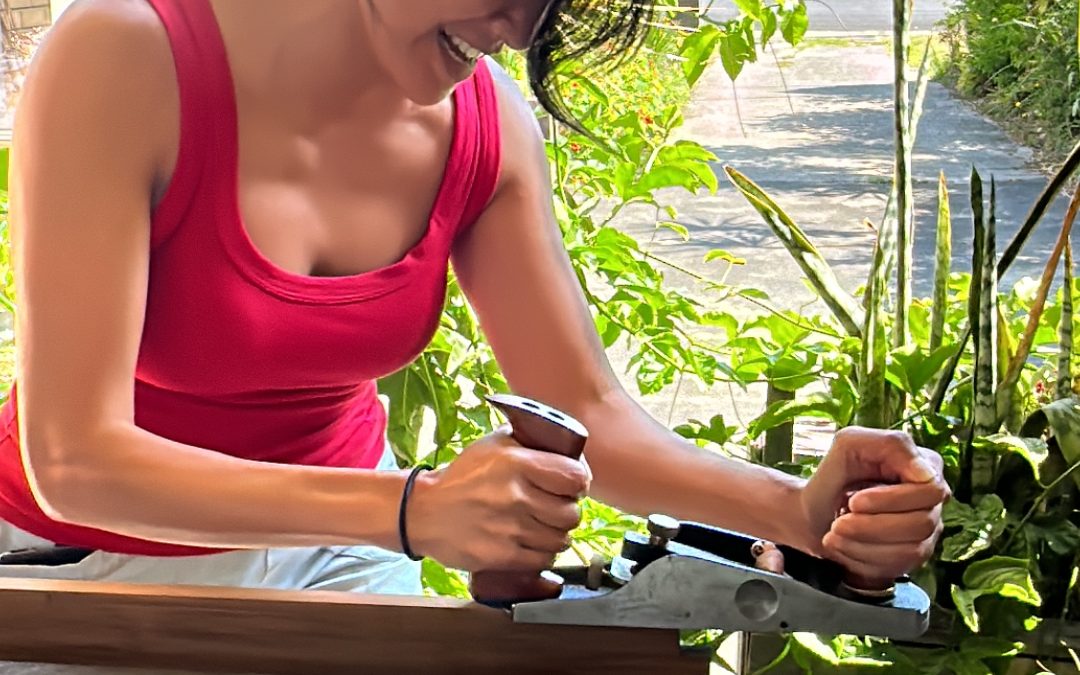
Can I learn woodworking even if I’m nervous?
You don’t need confidence before learning woodwork. Discover how nervous beginners become capable woodworkers through patient teaching, practical skills and supportive workshops.