When does a woodworker become a teacher?
People often search for how long it takes women to become woodshop teachers, as though there must be a certain number of years, a qualification or a level of skill that gives someone permission to begin.
Here in Australia, I would usually say woodwork teacher or woodwork workshop teacher, but the question underneath is the same.
When are you ready to teach someone else?
Many woodworkers imagine they must reach a particular point first. They need more experience, greater confidence, perfect joinery or the ability to answer every question.
I do not believe teaching begins there.
I think we are all teachers from the moment we can show another person something we know. We may do it patiently or impatiently. We may explain it beautifully or make a complete muddle of it. The desire is still there. We want another person to understand.
That instinct often arrives long before we feel able to call ourselves teachers.

You do not need to know all of woodwork
Woodwork is such a wide and varied field that the word itself can make people feel they must know everything.
Woodwork might mean turning a bowl on a lathe, driving a screw, cutting a dovetail, building a house, making a jewellery box or framing a picture. Telling people you teach woodwork can feel a little like saying you are a doctor and then being expected to understand every part of the human body.
No one knows all of it.
No one needs to.
If you know how to drive a nail straight, explain what the numbers on a drill mean or measure accurately for a small project, you already know something another person may be longing to learn.
That can be enough to begin.
Teach the part you know.
You do not need to start with a full workshop, a complicated project or six students standing around waiting for your wisdom. You can begin by showing a neighbour, a family member or a child how to do one small thing.
Choose something you understand. Read up on the safety requirements first if the task involves tools. In the same way that a learner driver needs to know the road rules, a beginner using tools needs a clear and safe framework.
Then share what you know.
When you reach something you cannot answer, you are allowed to say, “I don’t know,” or, “Let’s work that out together.”
Those words do not make you less of a teacher. They make you an honest one.
Teaching is an exchange
For a long time, mainstream teaching was built around the idea that the teacher held the knowledge and the student received it. The teacher spoke. The student listened. The teacher knew. The student waited.
Learning is far more alive than that.
The student brings their own intelligence, questions, experience, uncertainty and way of understanding. Teaching becomes much more useful when both people are involved in the discovery.
It becomes an authentic exchange.
Many times, I have been explaining a technique when one student has understood me and another has not. The first student will turn and explain it in the clearest possible way.
Sometimes their explanation is better than mine.
I write it down.
From then on, I use their words.
A learner who has only just understood something can be a wonderful teacher because they still remember where the confusion lived. They have not yet forgotten the small step that made everything fall into place.
The teacher may hold the structure, safety and pace, but understanding can arrive from anywhere in the room.

The teacher must see the student
A woodworker can demonstrate a technique perfectly and still miss the person standing in front of them.
I have observed many woodwork teachers over the years. Often, they know their craft extremely well. They understand the tool, timber and technique. Yet the class is large, the teacher is busy telling, and the opportunity to notice what is happening for an individual student disappears.
The teacher becomes so involved in the telling that they forget to see.
This is one reason I keep my workshops small. With four students, I can scan the room constantly. I can notice a face change, a hand hesitate or someone glance towards the student beside them to see what comes next.
Understanding shows itself in many ways. It can appear in the hands, the body, the expression on someone’s face, the question they ask or the silence that follows an instruction.
Sometimes a student will say they understand when they do not.
I once asked a woman directly whether she had grasped a particular technique. She said yes. A few minutes later, it was obvious that she had not.
When I asked why she had not told me, she said she did not want to hold up the group.
Everyone was listening, so I spoke to them all.
“This is not your job. That’s my job.”
It was my responsibility to manage the time and pace of the workshop. Her responsibility was to learn. She did not need to protect the group from her own questions.
After that, she relaxed.
This is one of the quieter roles of a teacher. We hold the pace so students do not have to. We notice confusion before it becomes embarrassment. We make room for questions and wait long enough for someone to take up the invitation.
The words matter
Teaching woodwork is not only about showing a technique.
What the teacher says is key.
The student does not always need the history of the tool, every fact you know or a long story while they are trying to remember where their hands should go.
They need the words that allow them to do the next step.
Stand like this.
Hold it here.
Place the mark here.
Move your hand to this position.
These instructions sound simple, but clear teaching is often found in simple language.
I have seen a teacher point to something a metre away and say, “Put it there.” The teacher knew exactly what “there” meant. The student did not.
Being succinct does not mean becoming a robot. Tone, warmth and timing matter. So does listening.
A student may show you through a sigh, a pause or a small comment that they are struggling. A thoughtful teacher notices and stays close enough to support them.
That does not mean taking over.
It means becoming their cheerleader.
It means saying yes in the places where something is working and allowing them to keep hold of the tool and the discovery.
I avoid saying no unless the student is about to place themselves in danger or damage the tool.
Most of the time, they need space to work something out.

Let mistakes do their work
A thoughtful teacher sets students up for success, then allows them to make mistakes within the safe arena that has been created.
Mistakes are not an interruption to learning.
They are learning.
A mistake pulls a student sharply into the present. They look more closely. They ask what happened. They begin connecting cause and effect.
When mistakes are treated as normal, the shock, shame or embarrassment has less chance to take over. Curiosity can remain.
This is one of my favourite moments to watch.
The student becomes completely engaged. They are no longer simply following instructions. They are at one with learning.
It is tempting for a teacher to rush in and fix the problem. We want to help. We want the project to work. We may also want to prove that we know what to do.
Fixing everything for the student removes the very part that could help them understand.
The teacher’s work is to stay close enough to keep the situation safe, ask useful questions and allow the student to discover what happened.
That discovery belongs to them.
Students need excellence, not perfection
A skilled woodworker may believe they need to demonstrate every technique perfectly before they are worthy of teaching.
I have never found that to be true.
When I taught beginners’ joinery, I could not always execute the joint perfectly while demonstrating. That was useful. The students saw the details that needed watching. They saw how small errors happened and how they could be corrected.
They were also more forgiving of themselves when they discovered that the task was not as easy as it looked.
Students need to see excellence.
They do not always need to see perfection.
Perfect execution can erode enjoyment when it makes the skill appear unreachable. A beginner may compare their first attempt with the teacher’s thousandth and decide they are failing.
A real demonstration shows the work as it is. It includes adjustment, observation and problem-solving.
Confidence can also come from different places.
One teacher may feel confident when a student says, “I loved the way you taught that.”
Another may feel confident after demonstrating something beautifully.
Someone else may need to know they can answer every question.
Confidence is personal.
For some of us, it begins with a knot in the stomach and a willingness to be authentic anyway.
Connection, humour, preparation and a willingness to make mistakes can create a quieter sort of confidence. It may not look impressive from the outside, but it can bring peace.
I did not plan to become a teacher
My own school reports said the same thing year after year.
“Nice student, but needs to concentrate more.”
I did not understand things in the way many other people seemed to. I had to work them out in my own way.
I still do.
After secretarial training and office jobs through my twenties, I took the plunge and trained as a carpenter and joiner. I imagined myself building, wielding a hammer and working alongside the lads on site.
I liked the lads. Growing up, I often felt more comfortable with them than with groups of girls.
When an acquaintance firmly encouraged me to apply for a government-funded job teaching woodwork to women, I was reluctant.
I said no.
She insisted.
I got the job.
I was given a small amount of train-the-trainer preparation so I could impart what I knew. Then I began.
I fell into teaching women in 1984.
What surprised me was how much I loved it.
I found it miraculous that I could explain how to use a hand plane in a short time, then help someone troubleshoot when it did not behave as expected.
I knew the words to help them investigate the problem.
I did not need to do it for them.
We could work it out together.
My own carpentry and joinery training had often felt like sink or swim, and there had been a great deal of sinking. I loved the craft enough to keep going. I took what I had learned into a shed with woodwork books, tools and pieces of timber and spent a winter refining the skills in my own time.
The struggle shaped the teacher I became.
I knew what it felt like to be capable and interested but not receive the teaching my brain needed.
So I began searching for the words that might help another person understand.

Loving woodwork is only part of it
A person may love woodwork deeply and still need to ask whether they also enjoy people.
A young man once came to my workshop to pick my brains about teaching. He had trained at a wonderful woodworking school in Melbourne and spoke excitedly about the skills, machinery and enjoyment of creating.
After listening for a while, I asked whether he liked teaching.
Did he understand that teaching includes many roles?
Sometimes you are a nurse holding a bandaid. Sometimes you are helping someone through frustration or disappointment. Sometimes you are settling anxiety, managing time or noticing that a quiet student has become lost.
Teaching is not only showing and telling.
It is holding students in all the parts of themselves they bring to the table.
Over the years, I have met several women who I believed would make wonderful teachers. They spoke with clarity and normalness. They liked people. They enjoyed the craft. Some were largely self-taught with expert guidance here and there.
I badgered one woman for a couple of years.
Eventually, she found the courage to begin teaching from home. She loved it. Her students loved her. She taught for several years.
She had not suddenly gained permission from the universe.
She had begun to trust that what she knew was worth sharing.
Begin by sharing one small thing
The smallest and safest way to begin teaching is to share one thing with one person.
Choose a simple skill.
Practise the lesson aloud before they arrive. Pretend the student is already standing in front of you. Listen to the words you use.
Keep each piece of instruction under three minutes. Shorter is often better.
Make sure you have duplicate tools so you are not tempted to take the student’s tool from their hands.
You might also record the session, even if you only record the voices. Listening back can be confronting, but it helps you hear your tone, how you answered questions, whether you spoke too much or too little, and where your instructions became unclear.
At the end, ask the student what they enjoyed.
Avoid asking them to critique your teaching.
They came to learn. They were concentrating on their own experience. They should not be made responsible for evaluating you while they are still finding their feet.
In the beginning, learn to become your own observer.
Once you are comfortable with one person, try two. Teach in an informal setting or borrow a bench in someone else’s shed. Keep the group small.
Too many students at once can overwhelm a new teacher and make it difficult to see what is happening.
Begin with sharing.
The word teaching can come later.
So, how long does it take?
There is no single answer to how long it takes women to become woodshop teachers.
Some women may have years of woodworking experience before they begin. Others may know one useful skill and be able to share it clearly, safely and generously.
A woodworker becomes a teacher when they stop worrying about knowing everything and begin paying close attention to what another person needs to understand the next small step.
They share what they know.
They stay honest about what they do not know.
They choose their words carefully.
They see the student.
They allow mistakes to become useful.
They keep their hands off the student’s tool and let the discovery belong to the learner.
Teaching is not the final reward for mastering a craft.
It is another way of practising it.
There is also something deeply nourishing in the exchange.
We all long to be heard. When we share something we love and it falls on ears that appreciate and relish it, we are given fuel for more.
The student carries away a skill.
The teacher carries away the feeling that what they know has reached someone.
That may be the moment teaching truly begins.
What Is a Tack Cloth and Why Use One Before Finishing Wood?
Fine sanding dust can remain on timber even when the surface looks clean. Learn how using two cloths at different stages can reveal a beautifully prepared surface before applying oil, wax, paint or stain.
The best beginners project
Start your beginner woodworking journey with the right first project. Learn why a simple shelf or box builds essential skills, confidence and the independence to tackle future woodworking projects with success.
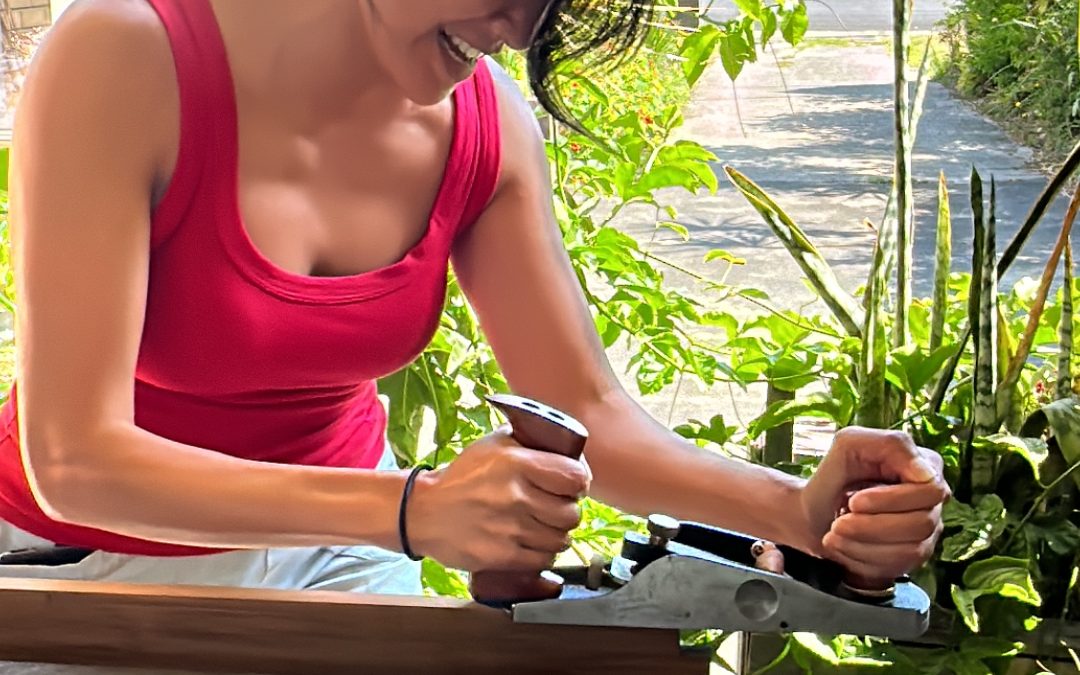
Can I learn woodworking even if I’m nervous?
You don’t need confidence before learning woodwork. Discover how nervous beginners become capable woodworkers through patient teaching, practical skills and supportive workshops.